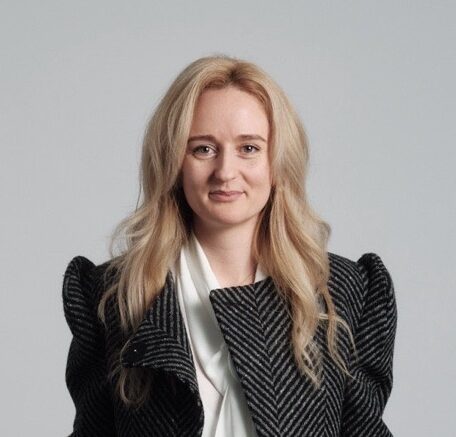
Financial stability as a strategic priority: CFO Edita Baranauskaitė reflects on 10 years at Staticus
May 16th is a very special day for Edita Baranauskaitė. It marks 10 years since she joined Staticus. And it is an easy date to remember because it shares the same day, if not month, as her birthday. In the decade since joining Staticus, Edita has grown from financial controller to CFO and board member, steering the company’s finances over a period when consolidated revenue has more than doubled and Staticus has expanded across Europe.
She sat down with us to share her reflections on that journey. She also shed light on why financial discipline matters more than many realise in construction, how Staticus balances financial resilience with bold ambition, and why never settle and extreme ownership have become watchwords for her approach.
Please could you provide a brief overview of your career at Staticus.
On May 16th it is 10 years that I have been at Staticus.
COO Ignas Stasiukonis invited me to join as a Financial Controller. Then in 2018 I was promoted to Group CFO and board member. When I started in my role as CFO, I did not want to reinvent anything, because a lot of things were already working well. My main task continues to be ensuring our financial stability and long-term financial health.
What factors have helped you to progress your career at Staticus?
During this time I finished an Executive MBA at the Baltic Management Institute (BMI). Our CEO Aušra is always encouraging us to learn new things and go for it. So I did. I have also become a certified board member.
My career growth has been in parallel with the company’s. Our presence in the UK market has grown significantly. We have added five or six new markets, including Iceland, Denmark, and the Netherlands. And we have established offices in Italy, Switzerland, and Austria.
As a person, I am always trying to learn new things, so being in an organisation that is growing and developing is very important. I think that is why I still find my work interesting every day, because we are changing and moving. We are a relatively young and dynamic team. So we try new things. Sometimes they work, sometimes they don’t, but we keep on trying. This is our never settle mentality.
Overall, I would say that the stronger the team is, the stronger you become. And I am very grateful to be part of a strong Executive team and a strong Finance team. This has definitely supported my growth as a professional.
What excites you most about your role as CFO?
Overall, what excites me most is that the role sits squarely at the intersection of finance and strategy. This is not a textbook finance function – every contract we sign has financial structuring implications. Every move in the FX or commodity markets feeds back into pricing, hedging, and working capital management. Finance is not supporting the business from the sidelines, but rather it is embedded in how we create and protect value. That is what keeps the work genuinely interesting.
As I mentioned, my main priority is securing Staticus’ financial stability and long-term financial health, which is vitally important in the construction sector. Project execution carries real risk: there can be delays, you might be left with materials bought for a project that has stalled. So you have to manage your working capital carefully.
Furthermore, warranties can run from two to twelve years, so clients need to know you will still be there and still be solvent. Without proper financial backing, you simply cannot issue the sureties required.
All of this puts huge emphasis on financial stability. To achieve this, my focus as CFO has been in three main areas.
Firstly, there is financial transparency across all our markets. We freely share our financial statements and annual reports with clients. Since our Head of Marketing Ieva Dauderyte joined, our annual Capability Statement has become a key document. This detailed breakdown of our finances and strategic outlook has made a real difference to how our clients see us.
Secondly, we are working continuously to make Finance integrated as a genuine business partner. That means we as a Finance team are not controlling or dictating, but instead trying to educate our colleagues. In other words, we don’t have controllers, we have Finance business partners who support budgeting and guide non-financial team members. Finance is not a back office function or support role, but a collaborative one that directly involves our CEO and is central to the running and success of the business.
And thirdly, we have to ensure the organisation is prepared for financial growth. When I joined Staticus, our revenue was around EUR 46 million. Since then, it has more than doubled to EUR 112 million. Importantly, the volume of façade we have produced and installed has not doubled, which means that the complexity of the projects we are working on has increased. The materials we are working with have changed, and the contractual side has become even more essential.
What is notable about Staticus’ approach to finances, particularly in the context of the construction sector?
The construction sector is known for its financial instability. The margins are tight, and problems like late payments or overleveraged balance sheets are common.
Staticus has very deliberately chosen a different path. It is a family-owned company and our shareholder is very conservative, so financial stability is a clear priority. We want to maintain a cash reserve, and we focus on long-term thinking, not just chasing revenue.
To me it is very notable that, even though we have grown significantly, we have always remained profitable. This profitability is extremely important, because it gives us the flexibility to balance our strategic ambitions with financial stability. We can deal with the actual realities of a changing market, rather than taking on risk just to hit a number. If a project is not right for us, we can feel confident in passing it up.
This balance between ambition and conservatism is really crucial to how Staticus works. Aušra is a very inspiring person and she wants to drive the business to move forward, going above and beyond what we do today. However, compliance has always remained equally important to growth.
So, it is all a delicate and exciting balance, and the financial team plays an important role here. We are very close to the commercial team. We will often say that Finance are the gatekeepers of profitability. What this means in practical terms is that no bids are submitted without the CFO and CEO’s approval.
How do you help bring Staticus’ culture to life within your team, and how does this culture show up in your everyday work?
Out of Staticus’ recently defined cultural behaviours, the most relevant within the finance team are never settle and extreme ownership. I have also received lots of feedback on these personally, and I feel these two behaviours are a driving force for me. Most probably, I have chosen team members who also have these qualities, and so they are prevalent in our team.
How do I understand never settle? It means being constantly inquisitive and never settling for an accepted and established way of doing things. Instead, we are constantly improving, growing, and moving forward.
For example, I am someone who will read and read again if I don’t know something. And I always try to look into other points of view to understand how we could approach a situation.
Never settle means good is not enough and you can always do better. Of course, there may be time limitations which mean you have to say “now it is good enough” because you need to move forward. But the instinct is always to push further.
A good example personally is with my Executive MBA studies. I already had a master’s degree in Economics from another university. I could have just skipped the thesis and settled for one diploma. But I thought to myself, if I can get two diplomas at once so why not do it, even if it is the more complicated route.
Tell us a bit about your life outside Staticus.
I love reading. For three or four years I somehow lost that part of myself, but now I am really back into it. I love romance books and detective novels, and I usually read around 50 books a year. I like reading to relax and switch off. I used to watch a lot of movies, but now I am into books, and sometimes I will read half a book before going to sleep.
Recently, I started doing sport. I was encouraged by Aušra, and actually we all go to the same gym – Aušra, Paulius, Ignas, and myself. I really appreciate the encouragement of doing this together, because I can see how exercise genuinely helps to relieve stress.
And of course, I love travelling, food and good wine: especially champagne.